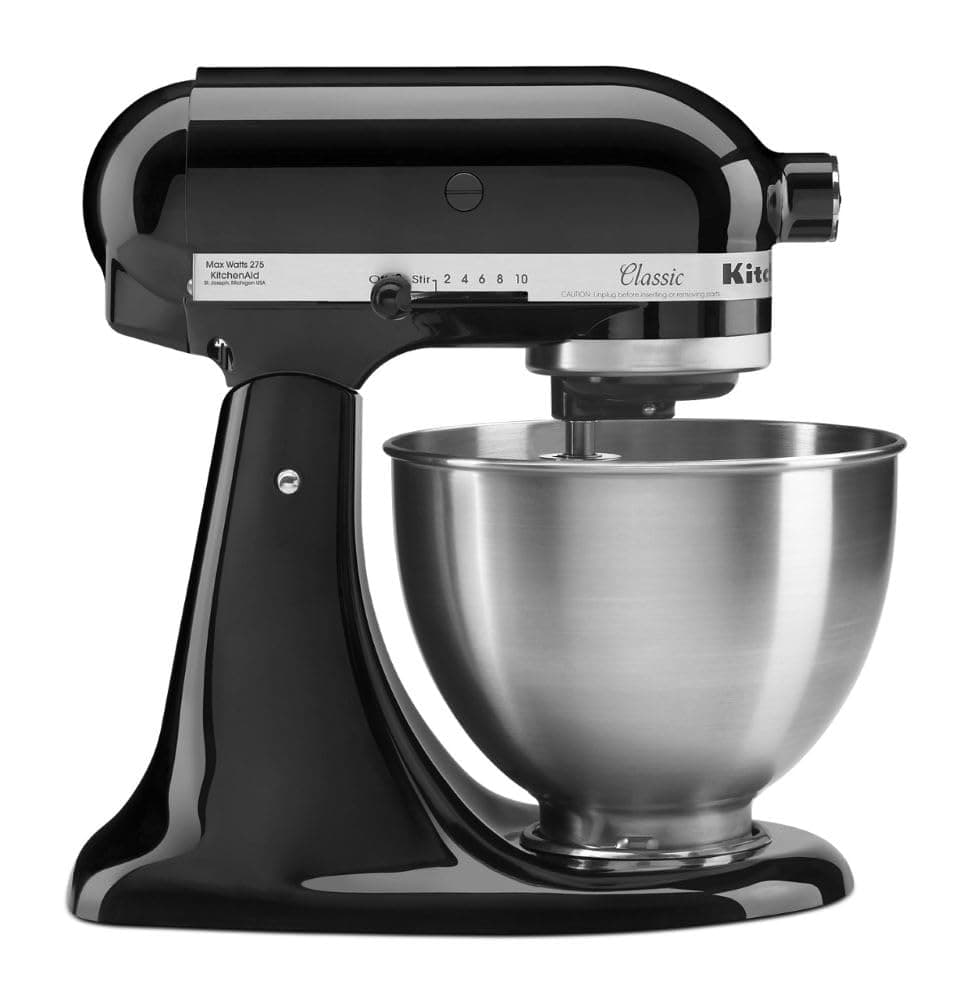
KitchenAid Classic Quart Tilt Head K45SSOB
Best for: serious home bakers and small-scale commercial operations mixing dough daily or multiple times per week
Check price on Amazon— $399Pros
- 6-quart capacity — 9% larger than Cuisinart — fits a full 5-lb batch of bread dough or 36 cookies in a single mix cycle
- 575W all-metal motor with reinforced gears — designed for 20+ years of daily use; 4.7-star rating across 8,920 reviews confirms legendary durability
- Coated flat paddle prevents dough sticking — reduces mixing time by 2-3 minutes per batch and eliminates need for manual scraping
Cons
- At $399, costs 2.7x the VIVOHOME price — only justified for professional bakers or those mixing 4+ times weekly
- Pouring shield design (not full splash guard) allows some flour escape during high-speed mixing — less effective than Cuisinart's enclosed guard
- No digital timer or speed indicator — requires manual monitoring; lacks modern convenience features found in $300+ competitors
Full review
Performance: 9.4 | Ease of Use: 8.7 | Cleaning: 8.5 | Build Quality: 9.6 | Value: 7.8
The 575W all-metal motor is the foundation everything else is built on. Reinforced metal gears, not plastic. Designed for 20+ years of daily use. The 4.7-star rating across 8,920 reviews — by far the largest sample in this comparison — tells you exactly what that durability looks like in practice. People don't leave glowing reviews for a mixer they've owned for a week. They leave them after years.
The 6-quart bowl holds a full 5-lb batch of bread dough or 36 cookies in a single cycle. That's 9% more capacity than the Cuisinart Stainless Mixing Paddle Splash and genuinely matters when you're baking for a crowd. The coated flat paddle keeps dough from sticking, which owners say cuts 2–3 minutes off each mixing session and eliminates most manual scraping.
Two honest criticisms: at $399, this is only justified if you're using it constantly. And the pouring shield — not a full splash guard — does let some flour escape at high speeds. The Cuisinart's enclosed splash guard is actually better on that specific point.
Pros:
- 6-quart bowl fits a full 5-lb bread dough batch or 36 cookies — 9% more capacity than the Cuisinart
- 575W all-metal motor with reinforced gears; 4.7 stars across 8,920 reviews confirms the durability reputation is earned, not just marketed
- Coated flat paddle prevents dough sticking, reducing mixing time by 2–3 minutes per batch and eliminating manual scraping
- At $399, costs 2.7x the VIVOHOME — the value case only holds for bakers mixing 4+ times weekly or running a small operation
- Pouring shield allows more flour escape at high speeds than the Cuisinart's enclosed splash guard — less effective for mess control
- No digital timer or speed indicator — you're monitoring manually, which feels behind for a $399 machine
Best for: serious home bakers and small-scale operations mixing dough daily or multiple times per week who need a machine built to last decades.
KitchenAid Classic Quart Tilt Head K45SSOB
serious home bakers and small-scale commercial operations mixing dough daily or multiple times per week